
Life Under Martial Law
Plus: news.

Welcome! It’s time for a new edition of the Animation Obsessive newsletter. Here’s what we’re doing today:
1) Inside a sequence from Patlabor 2.
2) Animation newsbits.
With that, let’s go!
1 – War comes home
It’s a famous moment. People know it who’ve never seen the movie; excerpts on YouTube have millions of views. Last month, we shared a clip of it that went all over.
It arrives halfway through the anime film Patlabor 2 (1993). You watch as a political crisis spins out of control in 21st-century Tokyo, and martial law begins. The Japan Self-Defense Forces send tanks down city streets and hover helicopters near skyscrapers.
Then, occupied by their own military, average people continue their everyday lives. Tokyo becomes almost surreal.1
“The very existence of military vehicles within ordinary everyday scenes — where they must not be — creates an inexplicable feeling of unease,” noted one writer. “This is precisely the core of the film.”2
The director responsible, Mamoru Oshii, is better known for Ghost in the Shell. There’s a case that Patlabor 2 is his best film, though, and the martial law sequence is Exhibit A.
He was making a point about Japan here. It was a country accustomed to peace at home, despite its involvement in conflict abroad. “I wanted to describe that fake peace,” Oshii said. Many in Tokyo knew war simply as footage from elsewhere, images on screens. When soldiers enter the city in Patlabor 2, the line blurs between screen and daily life. Suddenly, nothing makes sense.3

The martial law sequence runs almost seven minutes, and Patlabor 2’s lead characters appear only in passing. Generally, we find them as bystanders, watching the military deployment get announced and then enacted.
Talking fades away after a while: Oshii’s powerful images and the music of Kenji Kawai take over. A montage of disconnected shots tells the story of the new Tokyo. “The Great Girder Bridge in Shinjuku. Silhouette of an armored truck [below it]. Everyday heavy traffic,” Oshii wrote of one. In another, he framed a tank like a “parade float.”
Meanwhile, elementary schoolers wave to a man in a war robot, which copies his movements as he waves back (to the “delight of the children”). And we see “military otaku,” one dressed in a Nazi uniform, pose for a photo with the JSDF.
The sequence is all statements, and it plays with symbolism. Often, Oshii shows the military through reflections or screens. One “very intentional” shot places a crowd in the background and, in the foreground, a monitor that displays a soldier. When a tank rolls past an office building, silhouetted people watch “like shadow puppets” from the windows. The contrast reveals the “peace inside the window” and the “war beyond the window,” wrote Oshii. His entire point is right there.4
He was trying to capture the distorted reality of the ‘90s, a world mediated by screens. Even soldiers at war felt distant from the danger they were in and the violence they committed, Oshii said.5 Like he put it in 1993:
We’ve reached a point where, constantly, we can only come into contact with reality through a kind of curtain, such as the fluorescent screen of a monitor. I’m not sure anyone can break through that curtain anymore. Even in the case of the Gulf War, I feel that even if we had actually landed in Baghdad at that time, the situation probably wouldn’t have changed.6
It’s haunting, and many times beautiful, to watch his exploration of these ideas in the martial law sequence. And the whole thing is uniquely Oshii: it’s his unorthodox style of filmmaking. He calls himself a believer in moments where “nothing happens and there’s no dramatic progression,” like Ghost in the Shell’s music break. These are the moments when the audience can process the film.7
Animation itself is minimal in this section — even by the standards of Patlabor 2, whose movement was stripped back on purpose. Oshii aimed for something cinematic, and, for that, he called stillness essential. Here, he put his focus on soundtrack and cinematography.
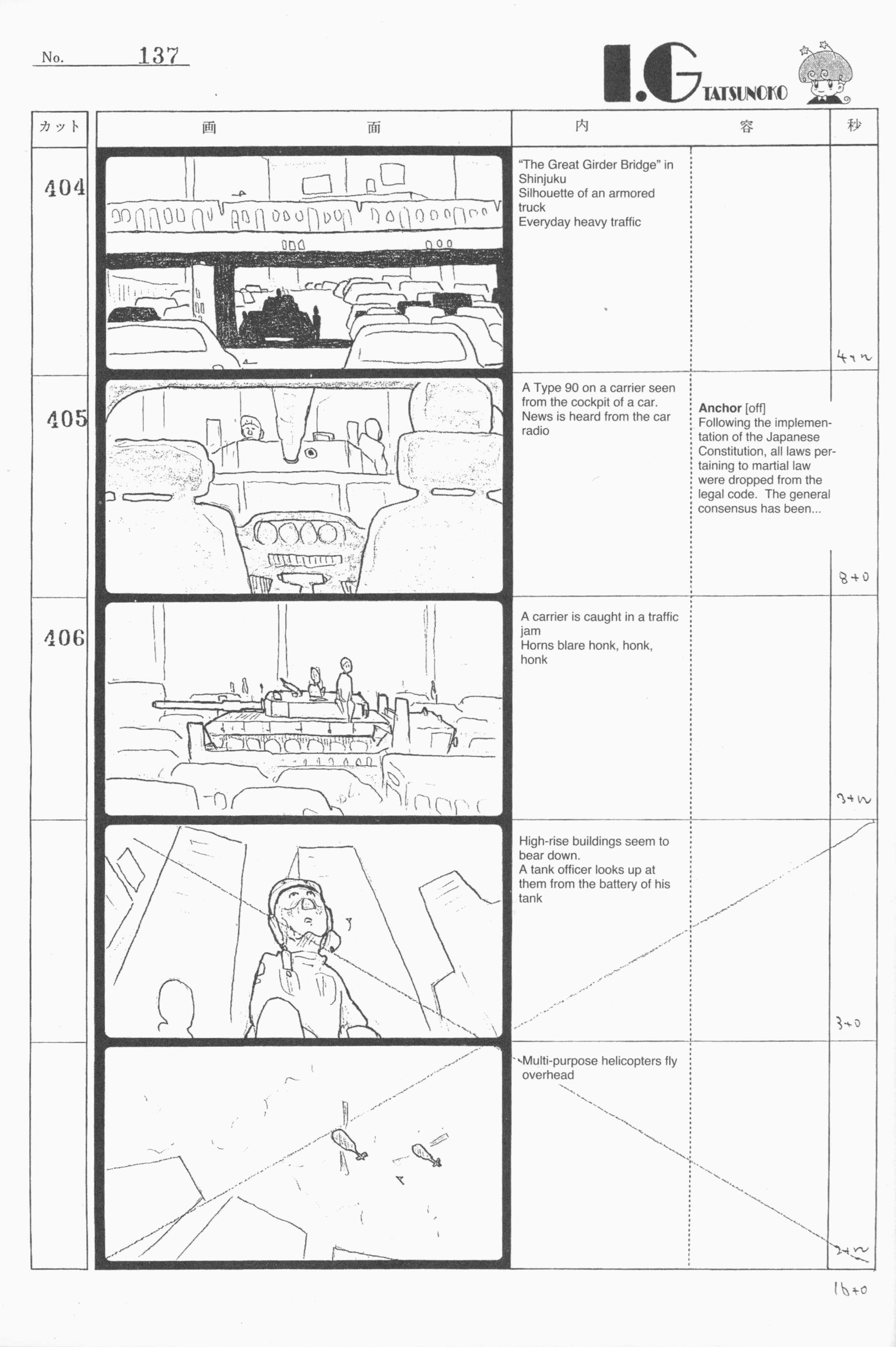
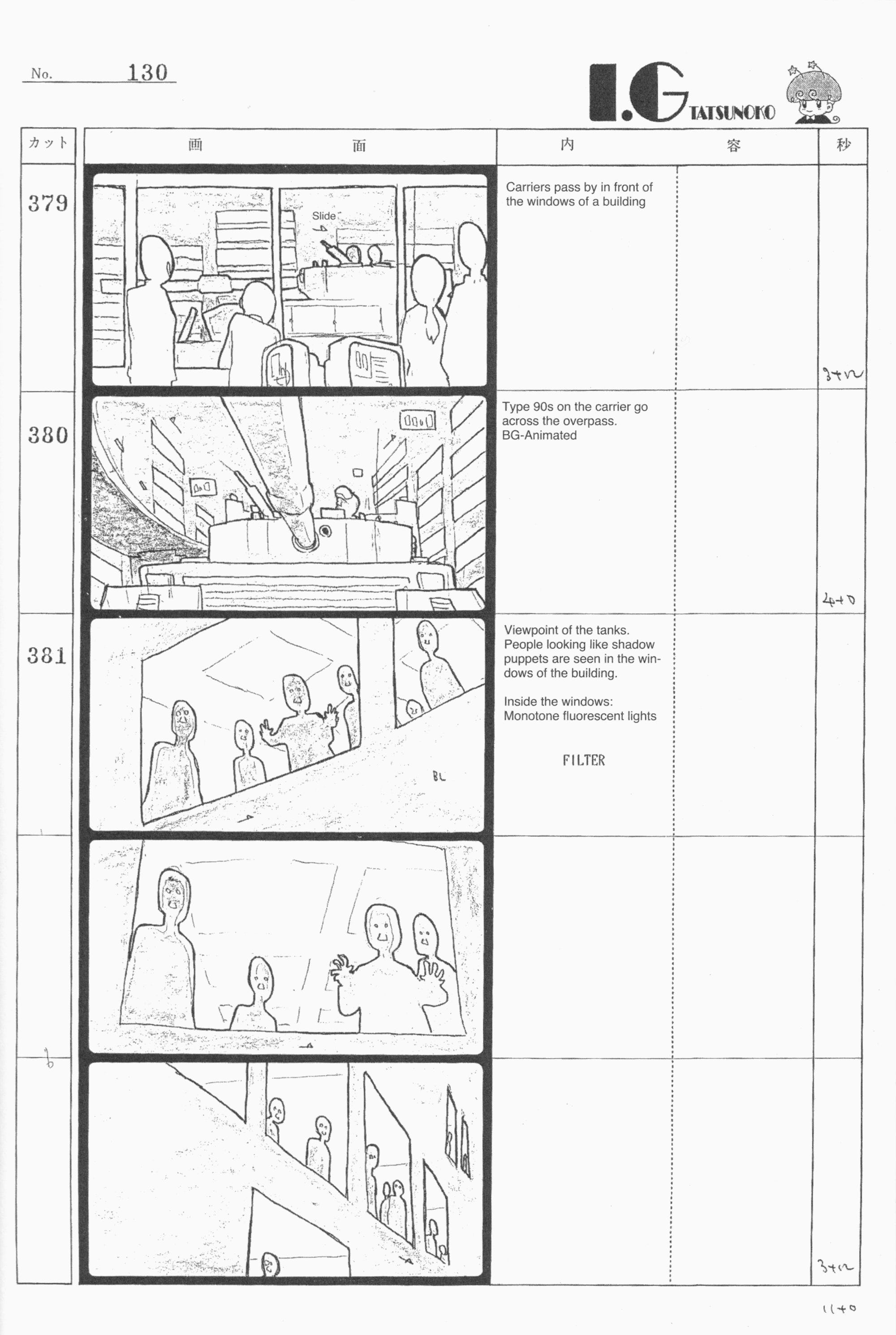
Oshii storyboarded this sequence alone, in rough sketches, as he did for all of Patlabor 2. That set up his compositions and editing. Then he worked with a crack team of layout artists to expand his drawings into blueprints for the animators and background crew.
He called Patlabor 2 a sort of “layout film.” With scouting trips and real photos as reference, the layout artists defined much of what we see on screen. As writer Ryusuke Hikawa explained:
Most of the shots in this film are without flashy movement. Instead, higher priority was placed upon the layout stage of the production to assure the needed mise en scène, and upon adorning individual scenes with fine details. … Indeed the layout stage was allotted twice as much time in the production schedule as the actual animation production … making it clear where the primary creative work lay.
And, for the military rollout and occupation scenes, Oshii put Satoshi Kon in charge.
Kon was a young industry artist: he wouldn’t direct Millennium Actress or Tokyo Godfathers until years later. But his skill was obvious, and Oshii was impressed. “The scenes I considered vital, I tried to leave to him as much as possible,” he said. Kon laid out more than 100 shots in Patlabor 2, which has just 872 shots in total.8
Some of the film’s trickiest perspectives and most detailed cityscapes appear in Kon’s sections. He’d been an assistant on the Akira manga — it helped him here. Kon approached each building in Tokyo as “a work of art in itself ... they all have their own individuality,” he said. And he drew everything with camera lenses in mind.
Oshii wanted his layout artists to emulate the look of lenses. He argued that animated films are “based on memories of live-action images,” rather than paintings. As a result, animation should obey the laws of the live-action camera. It was part of his pursuit of realism, in Patlabor 2 and beyond.9
At Oshii’s request, Kon drew the martial law sequence mainly to resemble telephoto and wide-angle shots. “I thought the scene where they look into the camera inside a convenience store was interesting,” Kon noted. That one called for extreme wide-angle distortion: Oshii needed the “strange sense of anxiety” that fisheye perspectives create. The cinematography puts across the vibe.
Also putting it across is Kenji Kawai’s score. With Patlabor 2, he tried for something “heavy and filled with a sense of coming dread.” Shots of the occupation are set to a track called Unnatural City, whose title fits. Kawai’s cold, mysterious, kind of tragic synths feel like these images of a Tokyo that no longer recognizes itself.10
Toward the end, as Unnatural City plays, an empty train passes in front of us. Its windows shine like fluorescent screens. We cut to a soldier’s face, watching. Oshii wrote in his storyboards, “Lights flash as it goes by, continuing endlessly. … The driver sits without moving, as though he is hypnotized.” Then snow settles over Tokyo’s streets, where only soldiers remain. “Not a single vehicle passes by,” his notes read.
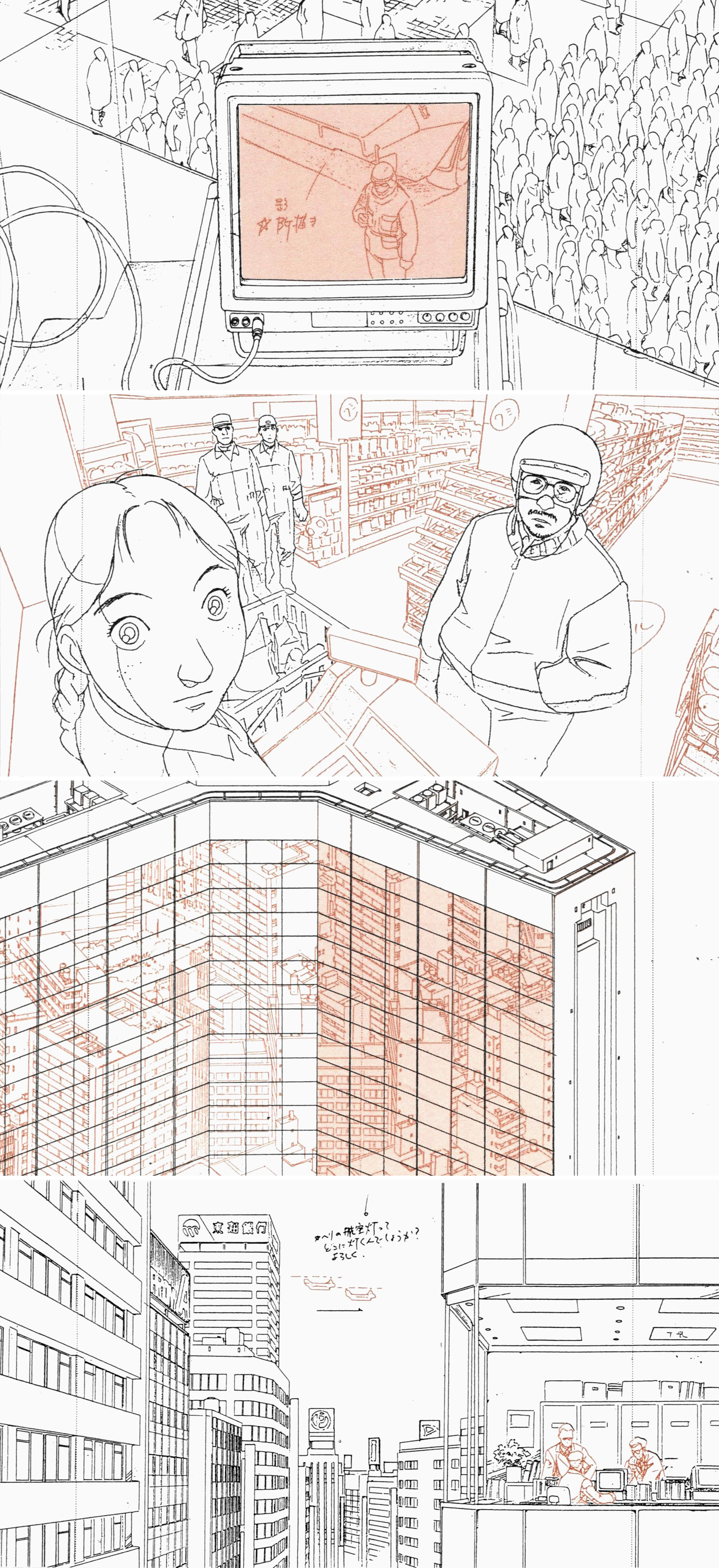
It’s impressive work that has real weight, and it was something unusual for ‘90s anime. Oshii was defying cliches. To him, the industry was suffocating under them.
During Patlabor 2, he noted that “the anime fan’s taste in movies is — to be blunt — extremely conservative.” Artists faced a demand for more and more of the same. This film itself was a bit controversial for sidelining fan-favorite characters. In Oshii’s words:
There’s little freedom in anime because if your anime does not conform to a certain pattern, the inevitable reaction is, “Well, what the hell is this?” But such a response isn’t painful only for the production side. It also represents a major loss for the audience. … [T]hey are peeking out at anime through a narrow slit — like the window of a tank. No matter how you look at it, that’s a real waste. I think it would be better instead to open the hatch wide, stick your head out and take a good look all around.
With Patlabor 2, Oshii made what he wanted to make, and it encourages that kind of viewing. As seen in the martial law sequence, he was speaking about the real world — and using film theory to do it.
There are guns and robots, sure, but they aren’t the goal. When Oshii shows an upside-down reflection of soldiers and then cuts to a high-rise office window, with helicopters in the background, we feel an energy. It comes from his shots and edits themselves, and the intention behind them.
That energy can reach viewers, too. The proof is the ongoing fame of these seven minutes, 32 years later. Oshii and his team expressed something very real and present in their eerie, unearthly scenes — and it’s hard to look away.
2 – Newsbits
A big story this week comes from Australia. Per Cartoon Brew, Glitch Productions has signed the Lackadaisy team to turn their pilot into a “full animated series,” as part of the studio’s plan to back outside projects.
As the premiere of I Am Frankelda nears in Mexico this month, word is that 15 minutes were cut out of the version that screened at Annecy, and another seven were added under the direct supervision of Guillermo del Toro.
Speaking of del Toro: he’s working with Netflix to open a stop-motion studio at Gobelins in France.
Also in France, La Poudrière continues to celebrate its 25th anniversary. The school’s alumni include some of the best in the business: Benjamin Renner, Charlie Belin and many more.
In Ukraine, the Lineoleum festival announced its winners.
Check out the well-made French film Cartagena (2024), newly on YouTube. Students at ESMA put it together.
Danny Volosozhar, a Ukrainian animator based in Croatia, released his film Miles and Flowers on YouTube. It’s an Unreal project in the gritty, Love, Death & Robots vein, with some very nice camerawork.
In China, Enlight Media saw its stocks drop after the collapse of Three Kingdoms: Starlit Heroes at the box office. Despite a solid score on Douban, it’s earned around $11.2 million, way below forecasts.
In Georgia and Russia, the festival What’s Happening? (Что происходит?) wants one-minute entries in any style or medium, from any country. We’re told that the program will hit Paris and Berlin as well. Thanks to writer Yuri Mikhaylin for sending this one to us.
Ireland’s John Kelly spoke to Cartoon Brew about his film Retirement Plan, which is Oscar-qualified. One of the best shorts we’ve seen this year.
Last of all: we published a brief history of pinscreen animation.
Until next time!
Brian Ruh also characterizes this section as surreal in his book Stray Dog of Anime.
This comes from Patlabor 2: The Movie Archives, a book included in the 2006 Limited Collector’s Edition by Image Entertainment. One of our key sources today.
Oshii’s quote comes from the book Anime Interviews.
All of these quotes from Oshii about the martial law sequence come from Methods from Layouts of Patlabor 2: The Movie and Patlabor 2: The Movie Storyboards (included in the Limited Collector’s Edition). We used both a lot today — Methods is our main source.
Oshii’s views on soldiers came up in Animage (October 1993) and Kazuchika Kise’s interview in Methods.
From Animage (June 1993), via Anim’Archive.
The Oshii quote comes from Anime Style #2 (September 2000), used a few times. He also discussed his views on stillness in Patlabor 2 toward the back of Roman Album 2501: Innocence Storyboard Collection.
Oshii’s words appear in Animage (May 1994). Matteo Watzky pinpointed the number of shots in Patlabor 2 in this article. Almost all the details about Kon’s involvement come from his interview in Methods.
There’s only one shot in the martial law sequence that has any flaws - there’s one scene of tanks turning through an intersection filmed from above and the tanks move as if they are paper cutouts without any weight.
Beyond that the scene is just as chilling today as it was thirty years ago. But now we have the Portland frog on our side
I can’t believe an animation based substack is where I learn that Japan was involved in the Gulf War…