
Soviet Anime?
Plus: news.

Welcome! Glad you could join us for a new edition of the Animation Obsessive newsletter. Here’s the plan:
1) The Mystery of the Third Planet and anime in the USSR.
2) The week’s newsbits.
With that, let’s go!
1 – A dream in outer space
Soviet viewers loved Japanese animation.
It might be hard to picture. The USSR vanished more than 30 years ago — but anime can feel new, like it only recently blew up. Yet animated movies from Japan were on Soviet screens by the ‘60s, and they were a bit of a phenomenon by the ‘70s.1
In 1980, director Andrei Tarkovsky (Stalker) made a note in his diary. “Today [my son] and I went to the cinema to see some Japanese cartoons,” he wrote.2
Puss ‘n Boots (1969) by Toei Doga was released in the USSR during the early ‘70s. The film had contributions from Hayao Miyazaki, Yasuo Otsuka, Reiko Okuyama, Yasuji Mori and more. Soviet critics raved about its “striking grace and elegance” and its “fascinatingly developed plot.”3 Many more Japanese films followed.
Soviet animators felt the tremors. At a Soyuzmultfilm meeting in 1973, the legendary Fyodor Khitruk said, “We have a serious competitor. ... I watched Japanese animation.”4 After Toei’s Ali Baba and the Forty Thieves hit the USSR in the ‘70s, the director of The Snow Queen called it “wonderful.” The Snow Queen was Miyazaki’s favorite film, and he’d worked a lot on Ali Baba. The admiration was now mutual.5
Another film with Miyazaki in its credits, The Flying Phantom Ship (1969), especially shocked the USSR during the ‘70s. Here was animation far darker, scarier and more violent than Soyuzmultfilm’s. Teenagers loved it — some used it as a date movie. People came in large numbers to watch.
It didn’t take long for this stuff to become a problem for Soviet animation. By the early ‘80s, Japan’s animated features had “firmly established themselves on the adolescent silver screen,” according to author Alexei Khanyutin. And he felt that Phantom Ship, in particular, had “thrown down a challenge to our animation.”6
The Soviets tried to answer that challenge — with a sci-fi feature that might appeal to the adolescent crowd.
In 1981, Soyuzmultfilm put out The Mystery of the Third Planet. The project was a “counterattack,” in Khanyutin’s words. “It’s indeed an attempt to fill a certain vacuum in the area of adolescent films,” admitted Fyodor Khitruk. “The Japanese have actually proven to be more far-sighted and resourceful in this regard.”

The Mystery of the Third Planet is a Soviet classic now. In its day, it was a massive hit.
When it opened at Moscow’s Barrikady Cinema (which had helped to popularize Japanese animation), one of the film’s staffers was stunned by the crowd’s size. “I remember how surprised I was; I even went up and asked if everyone was really queuing to see this film,” she remembered.7
That staffer was Natalia Orlova, the production designer. Her drawings defined the wild worlds of this film, and almost all of the characters within them. The star, Alisa, was unconsciously based on Orlova’s own daughter. The endless downer Captain Zelyony took his appearance — again by accident — from her husband. The six-armed alien Gromozeka came into existence when Orlova looked at a can of corn one day.8
She’d been chosen for this role by director Roman Kachanov. He was famous: the Cheburashka films were his, as was The Mitten (1967). But he insisted that Orlova treat him as a peer. Under his guidance, the team became a “family.” And he gave Orlova and her characters much of the credit for the film’s appeal.9
Science fiction wasn’t the norm in Soviet theaters. When Kachanov began this film in the late ‘70s, he studied foreign movies to prepare. And he had no interest in doing a hardcore project: he aimed for a “modern fairy tale film” with relatable characters.10
Orlova wasn’t adept with technology or mechanical drawings, but Kachanov assured her that it didn’t matter. “Don’t worry,” he said. “We don’t need science fiction; we need a kind, good film. Whatever you come up with, that’s what will happen. In animation, even a kettle can fly.”

Third Planet isn’t an easy film to describe to someone who’s never seen it. The story progresses like a dream, flowing from one event to the next without much foreshadowing or follow-through. It’s also slow and immersive — with detours and long scenes, and spacy music that hypnotizes. You sink into these bizarre places, and the film’s 50 minutes pass in a trance.
It was something irresistible to younger viewers. As a commentator wrote in the 2000s, “[Y]ou will not find anyone born in the ‘60s or ‘70s who wouldn’t gratefully and joyfully recall ... watching and rewatching The Mystery of the Third Planet in their childhood.”11
The story follows Alisa, her professor-father and Captain Zelyony as they search for rare animals in space. Some kind of conspiracy unfolds — although, again, in a dreamlike way. Fyodor Khitruk compared the story unfavorably to Japanese films, which each had “an interesting, exciting plot that, as a rule, is very well and very professionally constructed.” Third Planet is far from the Chekhov’s gun approach.
It isn’t clear how this film was meant to compete with Japan. Like Phantom Ship, it’s feature-length and sci-fi. And Roman Kachanov pointed out that its source novella (Alisa’s Journey, 1974) was “written for adolescents and about adolescents.” But Third Planet still has few similarities with the imported competition — films like Horus: Prince of the Sun and Taro the Dragon Boy.
In the end, though, none of those concerns mattered. Kachanov and his team made a film that’s almost impossible to hate: it’s funny, weird, relaxing and good-natured, and people were won over.

Third Planet looks amazing, too. Orlova’s designs are paired with movement that feels never-ending. The visual creativity — a flying space cow, a mirror plant, a rock that projects its memories as holograms — comes alive. The team’s achievement is very obvious in that recent Treasures of Soviet Animation restoration. (For transparency: we’re involved in a few future releases by Deaf Crocodile, the distributor of that disc.)
Plus, Kachanov’s focus on character is shot through every scene. He was a believer in what he called “planned inconveniences.” By that, he meant unnecessary animation that adds personality. As he explained:
A live actor, a live person, makes a lot of “excess” movements, entirely without thinking about it. You sit down on a chair and instinctively straighten your clothes. You rise from a chair and — without thinking, involuntarily — shake off the crumbs clung to your clothes. You put a dot on a blackboard with chalk and automatically turn the chalk so that the dot gets thicker. But when an animator animates a drawing or a puppet, they forget about this. … And the character becomes like a moving robot that has no incidental or excess movements, nor life-like details, and the viewer subconsciously feels that there is no life in the scene.12
He pushed his artists in the other direction. Third Planet is full of needless stuff. Early on, a stack of paper falls to the floor and Alisa picks it up. There’s no story purpose, but it adds. Elsewhere, her father’s glasses slide down his nose, and she brushes her hair out of her face (a lot).
Around 20 minutes into the film, the leads fend off a robot ambush. Then they pause for a moment to collect themselves, in silence. The scene deflates — but it’s inside this space, which is “too long” by a few seconds, that the characters prove they’re alive.
That was Kachanov’s style in general — the human touch, even with its inexactness. A few years after Third Planet, he remarked on the rise of computers in animation:
… a computer can be employed as a supporting tool wherever it does not limit or impoverish the human foundation that underlies art.
The liberation of humans from creative work is illusory. Thinking with the help of a computer — it’s nothing more than a myth spread by technocrats. The machine standard … cannot, at least at the present level of development of cybernetic technology, replace the living breath of line and expressive emotional forms produced in animation by the trembling hand of an artist.
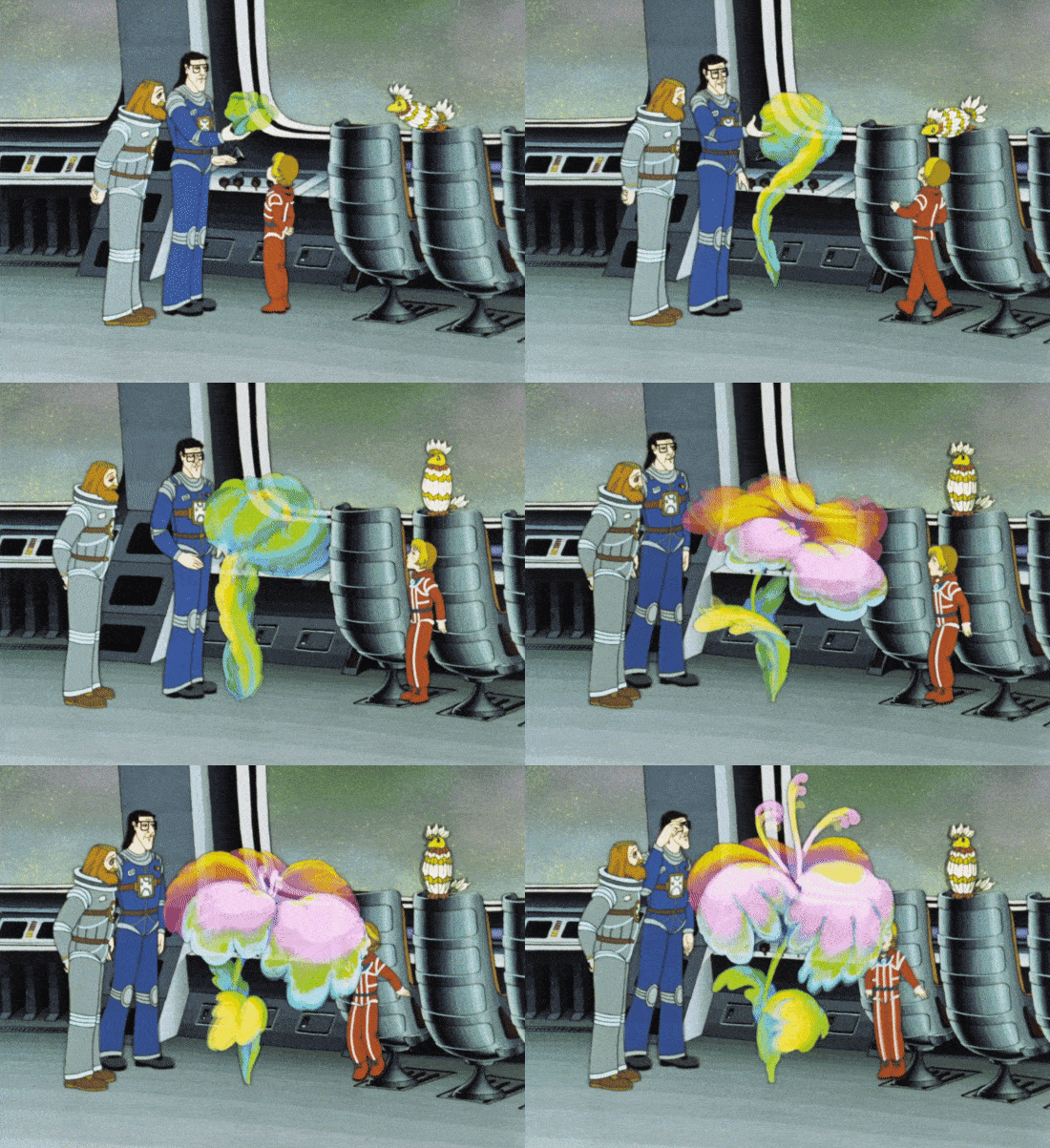
Third Planet itself is an organic, humanized type of sci-fi. It’s full of lively imperfections — and the team wasn’t trying for the cold, imposing, Space Odyssey vibe. Here, even the aliens act like people, and even the robots seem to have blood running through them. Things stay friendly, mostly. Even the dark parts aren’t particularly dark.
“Without pretending to philosophical significance,” Kachanov said, “our film at the same time shows humans in the cosmos not as warlike monsters or as the playthings of blind forces and hostile elements, but as reasonable masters of outer space, affirming here the fundamentals of goodness, justice, friendship and mutual understanding.”
Those were party-line words in Soviet times — which painted over the cynical realities of life in the Union. In fact, the darkness that Japanese animation snuck into theaters, past the censors, was partly why it was so magnetic. A generation of Soviet kids would watch Barefoot Gen (1983), with all the nightmares that entailed.13
But Kachanov seemed to believe in these ideas. Their presence in his films was important to him. Around the time of Third Planet, a journalist asked about the ideas that mattered to him most as an artist. He replied, “The idea of good.” For Kachanov, that applied equally to kids’ films and adult ones. He even refused to kill off his bad guys.14
Kachanov grew sick during Third Planet. His hand started to tremble, and he was diagnosed with Parkinson’s in the early ‘80s. After his death in 1993, Natalia Orlova continued to repeat the beliefs he’d championed: the need for “warmth” and “goodness” in animation. They were the beliefs behind the Cheburashka films, maintained in this sci-fi experiment that his direction and her design made possible.15
The result wasn’t Soviet anime. Other things got closer: co-productions with Japan like Twelve Months (1980) and the canceled Jules Verne project. But Third Planet found its own way into the memories of young people back then. Its means were quieter than the robot rampage from The Flying Phantom Ship — but they still had an effect.
2 – Newsbits
The Mexican film I Am Frankelda has a new teaser with making-of footage. A wide release is due in Mexico this fall (via Cinépolis). Directors Roy and Arturo Ambriz say the film’s performance at home will determine its distribution abroad.
In America, Nickelodeon canceled The Tiny Chef Show. The animated response by its team went extremely viral. “It’s more marketing in two days than we ever had with Nickelodeon. It’s been heartwarming,” co-creator Rachel Larsen told Vulture. The show is planned to continue — independently, if need be.
El Taller del Chucho (Pinocchio) is working on a new stop-motion project in Mexico. Details are scant, but it’s tied to Little Nightmares. See the clip.
In America, The Hollywood Reporter revealed that Warner and the Akira rights have parted ways. The company got them in 2002 — making the film “one of the longest development hell escapades in Hollywood history.”
In Japan, a new book of Hayao Miyazaki’s concept sketches will arrive in July. Its title is Nausicaä Prehistory, and it features art from unmade projects like Rowlf.
On that note, two other collections of Miyazaki’s artwork were announced in Japan: one for Porco Rosso, and one for Whisper of the Heart and On Your Mark.
In America, Max has the Looney Tunes feature. Screenwriter Kevin Costello noted on Twitter, “The movie we sold to HBO Max, which was abandoned by HBO Max, and subsequently sold to Ketchup Entertainment, is now streaming on... Max, the streaming service formerly known and soon-to-be-known again as HBO Max!”
Dansker just picked up €500,000 from the Eurimages fund. It’s the next film by Flee’s director — Jonas Poher Rasmussen of Denmark.
One more from America: California’s government pushed through a $750 million tax credit aimed at film and television, including Hollywood animation.
Last of all: we looked at two remarkable sequences from the films Bobby’s Girl (Japan) and A Drop Too Much (Czechoslovakia), and at what they say about filmmaking.
Until next time!
The history of Japanese animation in the USSR was explored in depth by Nikolai Kornatsky in Cinema Art (5/6 2022). His article was our lead source for much of today’s issue, and his footnotes were a treasure map.
From Cinema Art (September 1971) and Soviet Screen (04/1971). As a note, before its wider release in the ‘70s, Puss ‘n Boots screened at a Soviet festival in 1969 — see Cinema Art (November 1969).
As quoted in Kornatsky’s piece.
See this archived interview with Lev Atamanov, the director of The Snow Queen. Miyazaki discussed his time on Ali Baba in Starting Point 1979–1996 (“Hayao Miyazaki on His Own Works”).
From Khanyutin’s interviews with Fyodor Khitruk and Boris Stepantsev in Cinema Art (August 1981, July 1982). The former was used a lot today.
For information and recollections about Japanese animation at the Barrikady, see here, here, here and here. Orlova’s quote comes from Nastroenie.
Orlova told these stories in the book Legends of the Soyuzmultfilm Studio, a key source. She noted in a recent interview that a few incidental background characters were handled by another animator on the team.
Kachanov gave her this credit during a 1981 TV news report on Third Planet. See it on YouTube — we used it a few times.
From Kachanov’s interview in Cinema Art (February 1984), one of our major sources.
From the Kachanov section in the book Our Cartoons (Наши мультфильмы).
See Kachanov’s essay in The Wisdom of Fiction (1983).
For anecdotes about the impact of Barefoot Gen in the USSR, see this blog post and this paper.
The documentary Roman Kachanov: Cheburashka’s Best Friend discusses his health. Orlova spoke about the qualities that animation needs in this interview.
Mistery of the Third Planet has also a magnificent soundtrack by Alexander Zatsepin.
https://youtube.com/playlist?list=OLAK5uy_nBiBwJu7aRv8ESTmkhjZW6DMxGdew_8Wc&si=z_xvxwYEbe-mIpHY
Great stuff, i’m also fascinated that you used some old, unknown, RUSSIAN! resources, it just shows how hard you work to get such results